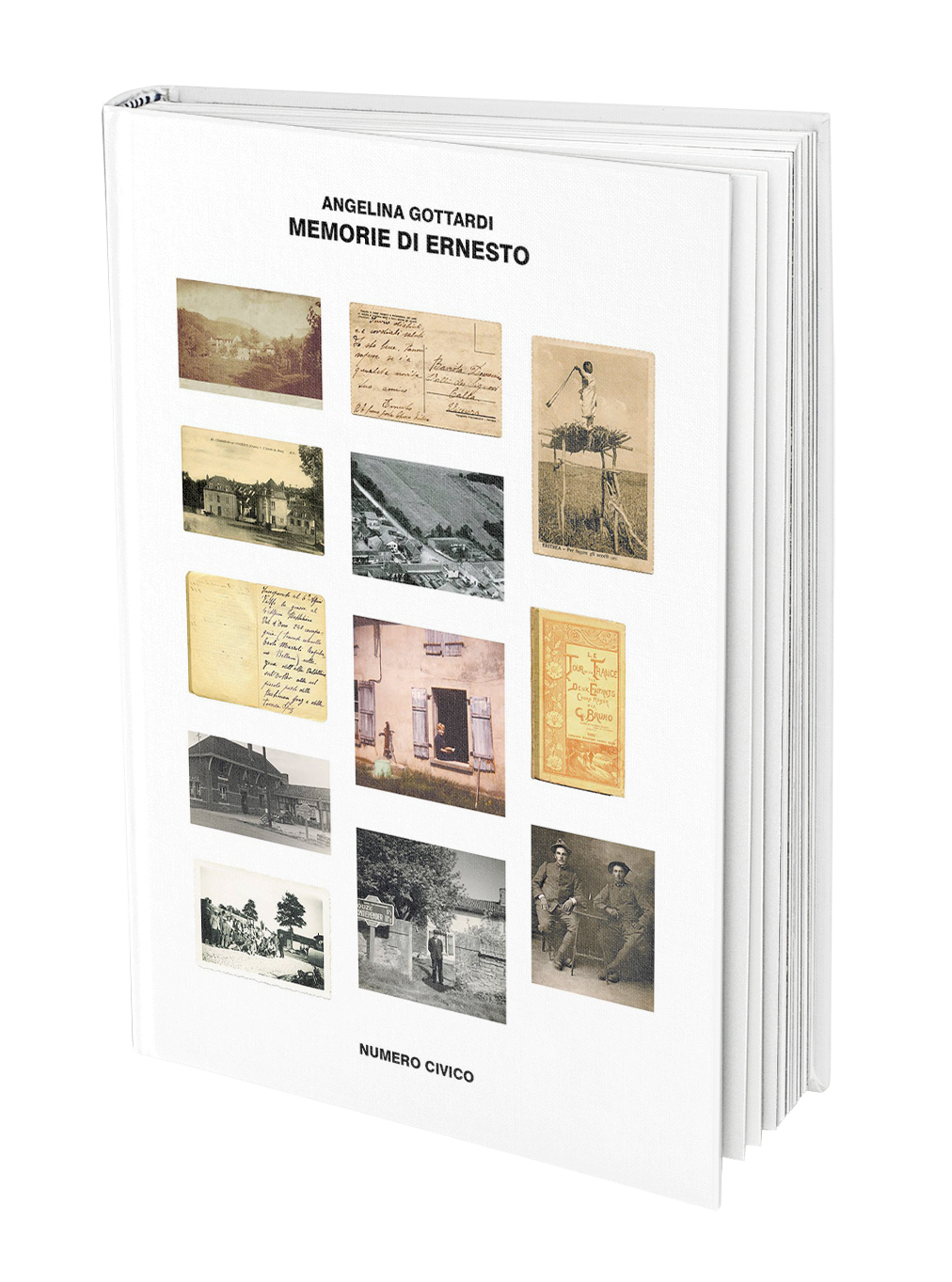
Presentation of the book “Memoirs of Ernesto”
February 18, 2017
It’s the 1920s. Cazzano of Brentonico (TN) Italy. A voiceover begins the telling of a story, the tone is light, the writing is clear. The story is that of Gottardi-Roso family. The narrative voice is that of Angelina, daughter of Luigi Giacomo Gottardi and Marianna Roso. ‘It is a voice, that of Angelina, that will be the undercurrent throughout all the pages Ernesto’s memoirs’:
Baby, I would enchant myself in front of the chest of drawers in my parents’ bedroom.
There were two large photos of my mother’s brothers: Uncle Giacomo, who emigrated to America, married with four children, and Uncle Ernesto, younger, who emigrated to France.
My sister Antonia was the oldest and kept in touch with both of them. Later on, I also asked for their addresses; I wrote to America and France. Ernesto responded to me immediately.
(page 3)
Incipit
The opening words of the book immediately reveals the threads, feeling and mood, which will lead us step by step through the story: a story of family feelings and a history of emigration, such as of many Italian people. Better say a history of “emigrations”, so numerous were those in ‘900 that involved thousands of families, and among them also that of Roso’s.
But, how to know mother Marianna, what feelings bind Gottardi family to Mom’s brothers, so close though so far away?
Flashback. To know the protagonists, we wind the course of events. Let’s go back to 1897, the day in which Ernesto Domenico was born in Giol in Valle dei Signori (Lords Valley), a town of Pasubio, in the province of Vicenza. Another time, another technique marks the hours of the day, another way of life. The voice and the writing of Angelina never part: there is no labour and no compromise to be overcome in telling this story, if in telling it there is feeling.
The scene shows us a rough landscape, the slopes of the Pasubio. We begin to know Ernesto and his family: places, people, everyday life. Ernesto will pass through childhood, adolescence and reach maturity in the difficult years of the Great World War.
There is a festival in Sant’Antonio. From Schio, small shopkeepers come to offer sweets and other things: if we help them push their carts a little, they give us five cents or a tiramolla.
The boys work hard gathering firewood to take to the baker in order to earn a few coins.
Cyclists coming from Schio ask us to push their bikes up to the Hotel Dolomiti: near there was the border, and you couldn’t pass. To go down, since there were no brakes, they attached large copper pieces to the back. It would smoke then. To go up to the Hotel Dolomiti, they paid a franc, and we were so happy! I was small, but my brother Giacomo and my sister Catterina would go there.
King Vittorio Emanuele III also passes by, along with all his entourage, and everyone with their “sgarmorette” [wooden-soled shoe] runs with to see and greet him.
(page 8)
In the beginning of the Great World War we will see him on the Pasubio Mountain building paths for mules and cable cars to reach the summit, and then on the highest peaks of the Ortler – 3600 meters above sea level – trying to defend an impossible border.
The next day, a new order: to do the chores to provide for the needs of the soldiers who are at three thousand six hundred meters. We climbed loaded with supplies, holding onto ropes.
After two days, it wasn’t fear, fatigue, or vertigo: I felt that my wrists could no longer bear it.
My hands were numb and I couldn’t tell if I was gripping the rope or not. I felt like I could fall into the void at any moment. The captain asks me what I want to do, and I tell him:
– I’d rather stay up here.
The next morning, with my backpack, I retrace the route of the chores for the last time and take my place at the front, in the ice galleries at the small spot of Bäckmann-Grat after crossing the Thurwieserspitze.
(pages 20-21)
From there, when the Italian counter-offensive starts, Ernesto will be behind the Arditi that cross Ponte nelle Alpi and reach Auronzo, then San Candido and finally Sterzing.
The war was over.
I, who have always been patriotic, was deeply struck by seeing so many prisoners battered and worn out, emaciated and humiliated: I felt great pity for them.
I would have liked to personally take care of them as brothers. Their conditions were worse, much worse than ours. Instead of cursing them, I would have wanted to ask for forgiveness.
Ahead of us marched the companies of the Arditi: thus we encountered no resistance. We always walked at night, with rations reduced because sustenance could not keep up. And always in silence, through the mountains, so that the walk doubled in effort. In the distance, some cannon fire echoed. We passed Ponte nelle Alpi.
Among the events of that time, there is one that remains more vivid than others because of the strong impression it made on me: a field hospital completely destroyed by a fire. Amid the smoke, dozens and dozens of stretchers lined up on which lay charred bodies. Only the metal frames of the stretchers remained, and the bodies, lying there, were black and unrecognizable in the most unexpected poses. Moving through in silence, I could not tell whether the bodies belonged to Italian or Austrian soldiers. I never knew.
(pages 24-25)
From there, when the Italian counter-offensive starts, Ernesto will be behind the Arditi that cross Ponte nelle Alpi and reach Auronzo, then San Candido and finally Sterzing.
A few days later, feeling like reading the newspaper and having some money in my pocket, I went out to go to the city. At the intersection, a kiosk displayed various newspapers; the first one that caught my eye was “Avanti!” and, being always a bit curious, I took it. Truly, I took it just as I could have taken “L’Arena” or “Il Gazzettino.”
I started walking slowly, reading my newspaper. Suddenly, I had the sensation that someone was in front of me. I looked up and saw a general. I snapped to attention. He, without saluting, said:
“Let me see your newspaper!”
I handed it to him. He told me to follow him. We went into the Court of the First Army, and there he asked for my name, surname, and service position. Then he signaled for me to go. I, feeling my anger rising at seeing my newspaper on his desk, asked:
“And my newspaper?”
He got angry and said:
“You’ll get your newspaper tomorrow.”
The next morning, the duty sergeant:
“Roso! Roso!”
Laughing, he handed me the newspaper along with a letter to deliver to the Command of the “Paloni” Company.
Conclusion: ten days of confinement, a wooden plank, bread, and water.
(pages 28-29)
The postwar period also appears difficult, for many people it will mean starting anew. Even for the Roso brothers. The first to go will be Giacomo, to the United States. The scene shifts to Pennsylvania. An Italian family, a story of the miners, in 1943 a collapse in the mine and the grief that affects the family.
Flashback: Ernesto and Giuseppe, certainly will not stay at home, there is a job for them, in Eritrea: “Partiti 28 luglio. Cominciato il 2 Agosto” (left on July 28. Began on August 2). It’s 1920: “Si stava costruendo una strada ferrata che andava da Cheren ad Agordat” (We was building a railroad that would connect Cheren to Agordat).
So, my task was to mark the workers’ days and to load and detonate the mines. The main part of the work was done at night.
Sometimes, I had a hundred mine charges to set off, and the danger was great. Everything was done by hand and with my teeth. Looking back now, I see that God helped me, and it’s a miracle that I’m still alive.
The work will last about two years. On their return, Ernesto will ask and get to leave for France with a friend, to work in the gold mines of Budelière: “Entrato in Francia il 29 luglio 1923” (Entered France July 29, 1923), he will write on a small agenda.
Getting to work by bike, he happens to see a big empty house, surrounded by a large garden of about 8000 square meters. He looks at this and he likes it: a sunny, comfortable house, in the center of a small town, Épothémont, on the four streets. It’s for sale. He participates in an auction for the house, and wins:
December 29, 1927, Monsieur Roso bought the house, paying 16,000, with notary fees of 5,360.
The neighbors, a bit jealous:
– You paid too much, Monsieur Roso!
The following year:
– You did well, Mr. Roso!
The third year:
– Mr. Roso, you made a good deal!
(page 39)
But the stories of emigration in the Roso family do not stop. We are in the Post Second World War period: Bruno, son of Giuseppe, recently married, with Flora Penzo and the little Sedina will try to find a job in another continent. This time the goal will be to travel even furter, to Australia. Joseph, the child who is born there, will be given the grandfather’s name as a sign of affection. Finally, the story of the children’s children, a route that goes up to the present: the great-grandchildren of a sister of Ernesto, Maddalena, also migrate to Australia. This is the story of Bruno and Giancarlo Facci and the story of their children.
Flashforward. We are now in the mid 50s. Angelina Gottardi, as a volunteer and then nurse at the retirement home in Trento, want to know and meet Ernesto, that uncle whom she has only heard about and from whom she has only a few letters. He is the brother of her mother Marianna, and quite some time ago he emigrated to France. For over thirty years he has been living in a village, Épothémont, two hundred kilometers from Paris.
The narrative now becomes more focused on Ernesto’s life, on the meeting between Ernesto and Angelina. Many scenes follow. Step by step, each of them redraw some particular event of Ernesto’s life. The time frame of the narrative is punctuated by the constant presence of Angelina, in summer and winter, in a physical pilgrimage that continues starting from 1963, a round trip between France and Italy. A journey tha lasts twelve years.
But we continue to follow Angelina’s writing:
It has been twenty-one days, and I am preparing to leave for France. In a large suitcase, I pack some clothes, maps, and scenes of Trentino, a moka for coffee, and a kilogram of yellow flour; we will eat Italian polenta together. I buy a small Italian-French dictionary and off I go. My uncle had described the entire itinerary to me.
– You will find me at the Troyes station. I will keep my right hand on my chest, missing the middle finger lost at work; that way, you’ll recognize me.
– No, uncle, wait for me at home, it’s simpler this way.
Thus, Milan-Chiasso, San Gottardo Tunnel, etc.
Switzerland is beautiful, everything is green: meadows, fruit orchards, pine forests, hills, and then very high rocky mountains, lakes, and streams. Lake Lugano is gorgeous; at dusk, it has lights like a Nativity scene.
It’s early morning; in a Troyes café, I have a coffee and wait for the bus to Épothémont, the uncle’s village, 200 km from Paris.
At 10:30 AM, we depart. In front of me, the vast French plains, many small scattered villages, some farms.
At 11:30 AM, in the village square, I ask for Monsieur Roso; but then, near a gate, the uncle appears. Thank you, Lord!
(page 43)
The summer in France:
It’s Sunday and I attended Mass in Montier-en-Der. I took the car. It was a lovely trip: eleven kilometers through fields, meadows, and woods. Vast stretches of green with groups of white and black cows. Many simple little houses, all in bloom. Here, women have an extraordinary passion for flowers and are supported by the environment. Most of the houses are one-story and surrounded by vegetable gardens.
On the way back, the driver let me off in front of my house.
I can truly say that the French have been très gentil, very kind, to me.
While I wash the dishes, I see Jean’s cows from the window and I think it would be nice if they belonged to my Severino and if everyone were here.
(pages 47-48)
In this story of uninterrupted travel, Ernesto will often be invited to return to Italy. So in the summer of 1965:
– Zio Bepi, there’s a surprise for you, a relative.
– Who’s that?
– Severino, your brother?
– No, he comes from France, your brother Ernesto.
(page 46)
Ernesto will return more than once to the native country: not just for a holiday, there are many grandchildren to meet and to get to know.
I am happy with everything and everyone; I only regret one thing: not having been able to visit your sisters and your brother. But if the Lord helps me, I will come again, starting from Brentonico, provided that you come with me.
In another letter, he will write:
In my mind, I have made a plan: next year, if the Lord helps us, we will go to see the Most High.
(page 260)
Dear to all of us, Monte Altissimo (The Highest Mountain).
Time to go.
My uncle is seventy-eight years old, I am fifty-eight. He is also tired of suitcases and travel. With difficulty and pain, he prepares to part with many dear things: home, environment, people; especially my uncle, after more than fifty years. But he is serene, in fact he is the one encouraging.
– I am old, I can no longer stay alone. It’s okay like this. June 15, 1975. The house is sold.
(page 53)
The Second of November, 1975, Ernesto and Angelina leave France forever. In a letter to his friend Jean, dated November 20, 1975, Ernesto writes:
Dear Jean, sorry for not writing to you earlier. The journey back to Italy went quite well. Our health is good, and we hope the same for all of you. For now, we can’t move around here; today is a bit unusual.
(pages 307-308)
It will not be long and in the house on Muredei Street, Angelina will start to collect the memories of Ernesto.
Fade out to black.
A Key chapter: the epistoraly dialogues
The correspondence with family, especially with the overseas relatives, represent the other soul of the memorial: a dimension perhaps more spiritual, more touching, more emotional.
If at some point the experience of travel will come to a natural conclusion, with Ernesto now fatigued and in need of care, and they, Ernesto and Angelina, both decided to return to Italy, to Trento, in the small Angelina apartment in Via dei Muredei, the experience of epistolary dialogue will continue in the rich fertile and fruitful correspondence, almost daily, that Angelina and Ernesto entertain with loved ones. The documentation has largely come to us.
This is the original path that unfolds along the Ernesto’s memories, told by Angelina: a thread that first leads us out in the world, and then brings us back home again, where feelings are taken care of.
Angelina has no doubts: for her, born in Genoa when the family was displaced because of the outbreak of First World War, living is an extremely complex thing. Her way of living is somehow a state of grace that accompanies her in the vast mass of experiences, not only and not so much lived by herself, the narrator, but rather along with all her loved ones, even with those who have left over the years.
How can one not imagine that they are still living with her every day?
The lives of friends, neighbors, and people she meets on the street while visiting Brienne-le-Château, or Montier-en-Der; and that sometimes “stop”, frozen, in photos taken with a Kodak bought in a kiosk at the station. A story that is well known when told by the protagonists of the Nouvelle Vague, that “slice of life” full of small and infinite life sequences characterized certainly by particular events and anecdotes, but never destined to fade.
But, as soon as Angelina has recalled this myriad of memories that illuminate her life and that of beloved ones, the story moves on once again. In this way there’s the intertwining of the beloved Mom words, recalled day after day, then those of the father, grandparents, uncles, cousins and friends with whom she lived her life with, in a life dedicate to others – to the sick, the humble, the defenseless.
Angelina takes us with her, wanting us to meet these souls and, leading us by the hand, she takes us into an infinite time, written in a lasting ink. This is a story that takes us from the beginning of the 19th century, the years in which her great-grandparents Giuseppe (Joseph) and Maria Maddalena (Mary Magdalene) lived, up until the present day, at least until December 30, 1988, the date of the last letter received by Angelina and published in this book of memories.
Contact
Stefano Giovanazzi t. 0039 0464 439936 m. 0039 329 4828149
Alberto Giovanazzi m. 0039 346 3570000